A worked practice for your team
Arrive in the end zone instead of waiting there
Time an off-ball arrival into a scoring zone rather than occupying it throughout the build-up.
ZIP includes the printable coach card, all three SVG diagrams, timeline and practice data. Extract the folder before opening the card.
Check the problem
The receiver waits beside the scoring line for the whole attack. A defender settles in front and the remaining teammates have little useful movement to find. More force on the final pass does not solve that static picture. Compare waiting at the destination with arriving from outside it.
Set up the space and roles
Mark an 18 × 24 m rectangle and a 3 m deep zone at each short end with eight cones. Keep 2 m clear around it, a 22 × 28 m footprint. Team A is 1/2/3 and attacks right in the diagrams; B is 4/5/6. Use one ball, no goalkeepers and no fixed end-zone players. For the rehearsal, B observes from inside its own half, clear of A’s passing routes.
Keep the rotation clear
Within each team, cycle the first restart taker through all three players across the rounds. After each restart, roles are free. In the rehearsal, every player completes carrier, support and arrival roles; nobody becomes a permanent scorer or observer.
See the practice in three steps
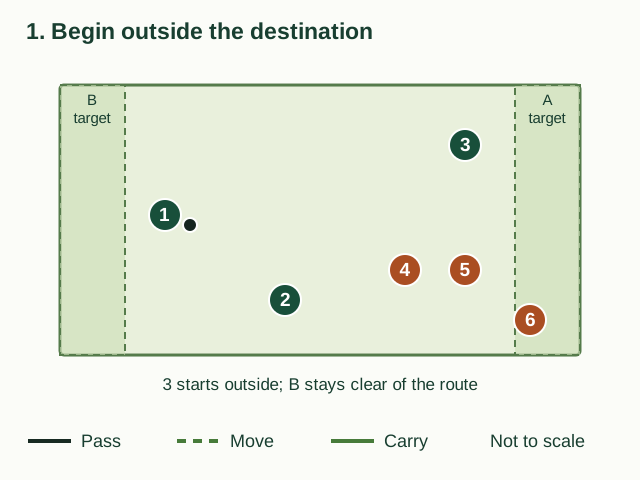
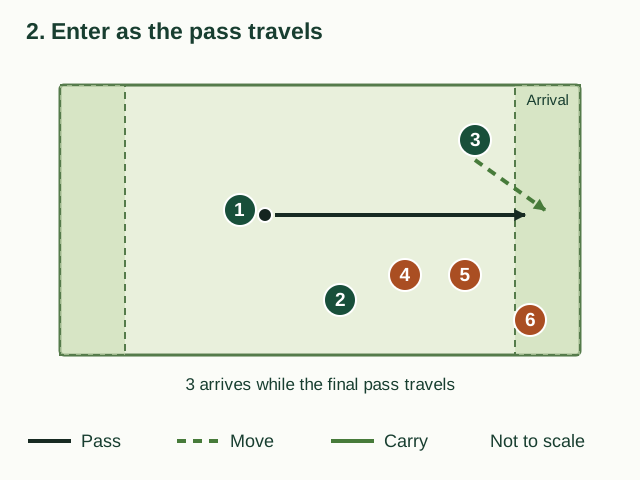
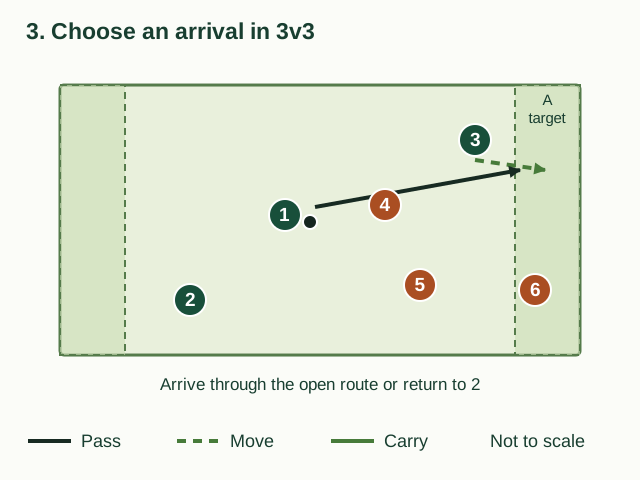
Schematic views, not to scale. Player numbers match the roles below. Dark arrows show passes, dashed green arrows show movement and solid green arrows show carries. Use the written dimensions when marking your area.
1. Begin outside the destination
2. Enter as the pass travels
3. Choose an arrival in 3v3
Your complete 30-minute plan
Briefing, planned role changes, water and reflection are included. Add rest or stop when needed; shorten active play rather than rushing a transition.
00:00–03:00 · 3 min
Check, explain and walk the layout
Walk one attack with 1 carrying, 2 supporting and 3 initially outside the far zone. Player 3 checks the ball, moves into the zone and receives a gentle pass. Show that entering early can close the route before the passer is ready. Return all three outside the zone after the attempt.
03:00–08:00 · 5 min
Prepare the movement
Use two two-minute unopposed rehearsals with a 30-second pause after each. A practises first and B second. Rotate carrier → support → arriving receiver after each attempt. The observing team describes whether the receiver entered before or after the carrier could see an open route. Walking movement and a settling touch are welcome.
08:00–17:00 · 9 min
Focused practice and role changes
Play three rounds of 2 minutes 40 seconds plus 20 seconds of rest. Use 3v3, with a point for a controlled ground pass to a teammate arriving in the far zone. A receiver must be outside the zone when the passer begins the final pass; they can enter as it travels. A player already waiting inside comes out before trying again. Defenders remain outside the zones and intercept ground passes only, staying 1 m from carriers and clear of runners’ paths. No foot or body tackles.
17:00–19:00 · 2 min
Water and reset
Pause for water and check the surface and clear buffers. Keep the same marked playing area and its clear outside buffer. Extra rest takes priority; shorten the next playing block if needed.
19:00–28:00 · 9 min
Use it in a game
Use the same three round lengths. Remove the entry condition and allow defenders into zones while preserving clear gaps and interception-only defence. A controlled ground reception in the far zone earns one point. Receivers choose whether arriving late still helps; there is no extra point just for running. After a score, the other team restarts from its own zone. After a ball out, the team that did not touch it last restarts from its own end. Opponents retreat 3 m. An early arrival can leave and offer again.
28:00–30:00 · 2 min
Reflect and choose the next step
Ask the receiver what showed that it was time to enter. Judge the usable reception and the available route, rather than rewarding the latest possible run.
Watch for a useful change
- Receiver begins outside the destination and watches the developing route.
- Arrival and pass meet without a hurried chase.
- Receiver leaves an unhelpful early position and offers again.
Make it easier
Return to one unopposed trio at a time and let the receiver enter before the gentle pass. Compare the timing without a defender.
When ready
Allow one defender to screen the zone entrance during the focused block. Keep the runner’s path clear and allow a supporting return when no arrival is available.
Ask the receiver what showed that it was time to enter. Judge the usable reception and the available route, rather than rewarding the latest possible run.
If conditions change
Stop active play when the surface, weather or available clear space is unsuitable. Use an indoor area only if it can hold the full written footprint and buffers. Otherwise keep the ball still, walk through the roles without pressure, and reschedule the live game. Extra rest takes priority over finishing the timetable.
Need a different group size or duration?
The worked example above uses the stated numbers. The related complete session has its own checked customizer, maps and rotations.
Open Meet the Moving PartnerCoaching principles and further reading
Movement can help a teammate become available for a pass into useful space.
Sources reviewed for this practice on 25 October 2026. Session Pitch created this worked example, timing, role instructions and diagrams; it is not a reproduction of the linked sessions. No FA or FIFA endorsement is implied. Live coaching effectiveness has not been evaluated.