A worked practice for your team
Change the angle before a ground shot
Move the ball sideways to create a clear ground-shot route around a fixed cone screen, then check the target again.
ZIP includes the printable coach card, all three SVG diagrams, timeline and practice data. Extract the folder before opening the card.
Check the problem
The player kicks directly at the target even though the ball is lined up with a screen, or moves their body sideways while leaving the ball on the blocked line. Compare the route from the ball before and after a small adjustment.
Set up the space and roles
Use two 10 × 14 m stations with a 4 m gap and 2 m outer buffer: a 28 × 18 m clear footprint. Each needs ten cones: four corners, two for a 2 m empty target gate, two for a 2 m screen and two marking the shooting line. Put the screen 3 m from the target and the shooting line 5 m from it. Shooters remain behind that line. Player 1 serves to 2; observer 3 stands on the side behind the line, outside the central 6 m shot corridor. Repeat with 4/5/6 and the second ball.
Keep the rotation clear
Start 1 server, 2 shooter, 3 observer; use the same order for 4/5/6. Rotate at every round pause in both blocks. Each child has one full shooting round per block; retrieving never creates an extra shooter or leaves a permanent server.
See the practice in three steps
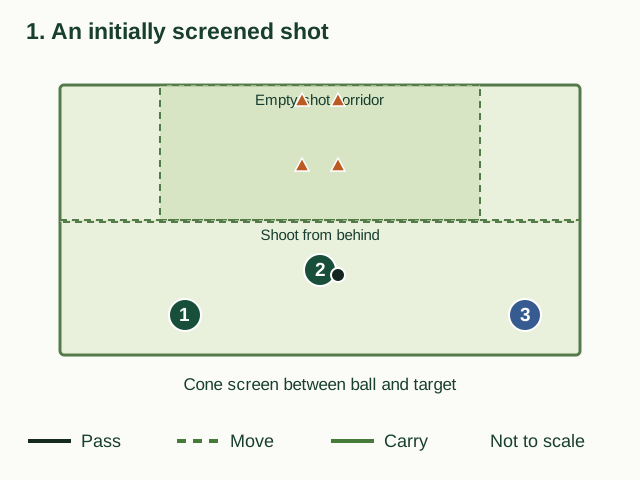
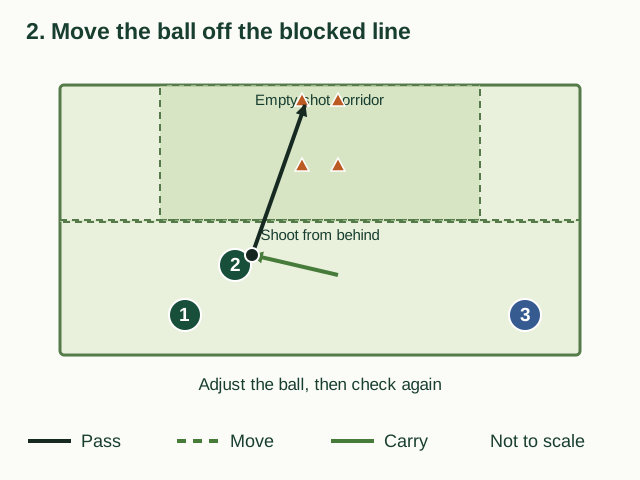
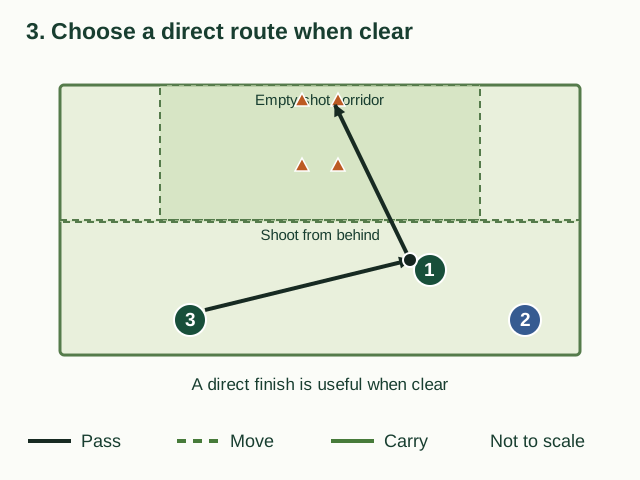
Schematic views, not to scale. Player numbers match the roles below. Dark arrows show passes, dashed green arrows show movement and solid green arrows show carries. Use the written dimensions when marking your area.
1. An initially screened shot
2. Move the ball off the blocked line
3. Choose a direct route when clear
Your complete 30-minute plan
Briefing, planned role changes, water and reflection are included. Add rest or stop when needed; shorten active play rather than rushing a transition.
00:00–03:00 · 3 min
Check, explain and walk the layout
Demonstrate a gentle sideways touch while remaining behind the shooting line. Look again from the new ball position: shoot only if a route around the cones is clear. There are no goalkeepers. Everyone else stays behind the line and outside the shot corridor.
03:00–08:00 · 5 min
Prepare the movement
Start with the ball still, a comfortable ground finish and no screen in the route. After each attempt, all three stop. The shooter retrieves only when the ball has stopped and the station is declared clear, then returns outside the corridor. Rotate after three attempts. Replace the screen before focused practice. Stop both stations before retrieving a ball from their shared gap or a neighbouring station.
08:00–17:00 · 9 min
Focused practice and role changes
Use three rounds of 2 minutes 40 seconds followed by 20 seconds to rest and rotate server → shooter → observer. Serve gently into the central starting position. The shooter adjusts the ball left or right, settles if needed, checks and aims a ground finish. One point requires the ball to pass around the screen and through the empty target. If both routes feel awkward, return to the server and reset instead of forcing a kick.
17:00–19:00 · 2 min
Water and reset
Stop every ball, offer water and rest, and check the same station and its clear buffers. Walk to the next roles while the ball remains still. Extra rest takes priority; shorten the next playing block if needed.
19:00–28:00 · 9 min
Use the choice in a game
Keep the same separated trios for three rounds with the same play and pause lengths. Before an attempt, the observer chooses the server’s left, centre or right starting delivery; they signal from their safe side position. The shooter may finish directly if clear, adjust the ball, or return it. A clear target finish scores one; an adjustment alone scores nothing. A miss or return ends the attempt. Stop all movement, retrieve, reset and serve again.
28:00–30:00 · 2 min
Reflect and choose the next step
Ask the shooter to point to the route before and after moving the ball. Repeat slowly if only the body moved or the finish still went straight at the screen.
Watch for a useful change
- The ball position changes when the original line is screened.
- Shooter rechecks the route after adjusting.
- Ground finish begins behind the line into an empty corridor.
Make it easier
Move the screen slightly off centre before the attempt and enlarge the target. Let the ball start still.
When ready
Vary the starting pass position before delivery. Keep the screen fixed during each attempt and allow unlimited preparation touches.
Ask the shooter to point to the route before and after moving the ball. Repeat slowly if only the body moved or the finish still went straight at the screen.
If conditions change
Stop active play when the surface, weather or available clear space is unsuitable. Use an indoor area only if it can hold the full written footprint and buffers. Otherwise keep the ball still, walk through the roles without pressure, and reschedule the live game. Extra rest takes priority over finishing the timetable.
Need a different group size or duration?
The worked example above uses the stated numbers. The related complete session has its own checked customizer, maps and rotations.
Open Aim at TargetsCoaching principles and further reading
A manageable shooting task can prioritise accurate placement and adapt target size or distance to the child.
Sources reviewed for this practice on 25 October 2026. Session Pitch created this worked example, timing, role instructions and diagrams; it is not a reproduction of the linked sessions. No FA or FIFA endorsement is implied. Live coaching effectiveness has not been evaluated.