A worked practice for your team
Explore an outside-foot ground pass
Explore a short outside-foot ground pass to a side window when an inside-foot setup would require an extra adjustment.
ZIP includes the printable coach card, all three SVG diagrams, timeline and practice data. Extract the folder before opening the card.
Check the problem
A child repeatedly moves the ball across their body before a short pass toward a nearby side teammate. A different foot surface might offer another option, but only if the pass remains controllable. Treat this as an experiment rather than a compulsory technique.
Set up the space and roles
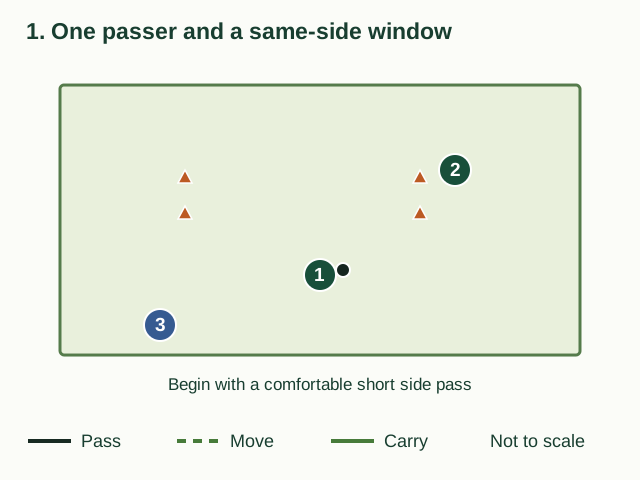
Make two 8 × 10 m rectangles with a 4 m gap and 2 m outer buffer: a 24 × 14 m clear footprint. Each station has four corner cones and two 2 m side receiving gates using four more cones. One gate is ahead-left and one ahead-right of the central passer, with a comfortable initial pass of about 2 m. Player 1 passes, 2 receives behind the chosen gate and 3 observes behind the passer. Players 4/5/6 repeat with the second ball.
Keep the rotation clear
Use 1 passer, 2 receiver, 3 observer and 4/5/6 in the second station. Rotate after every three deliveries, including misses, and carry the order across round pauses. No player stays observer because a pass was unsuccessful. The receiver walks between gates only while the ball is still.
See the practice in three steps
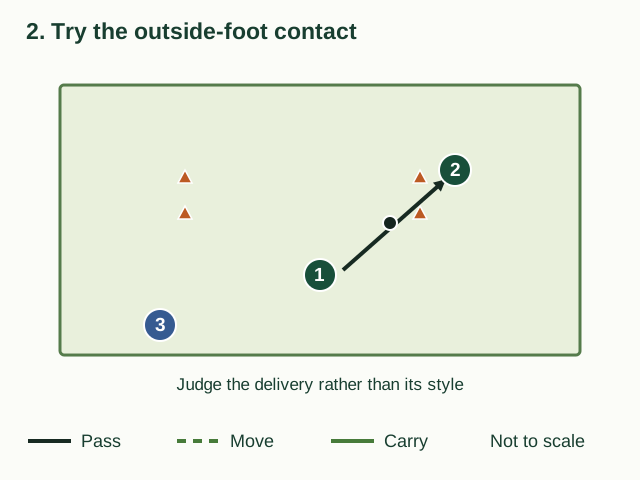
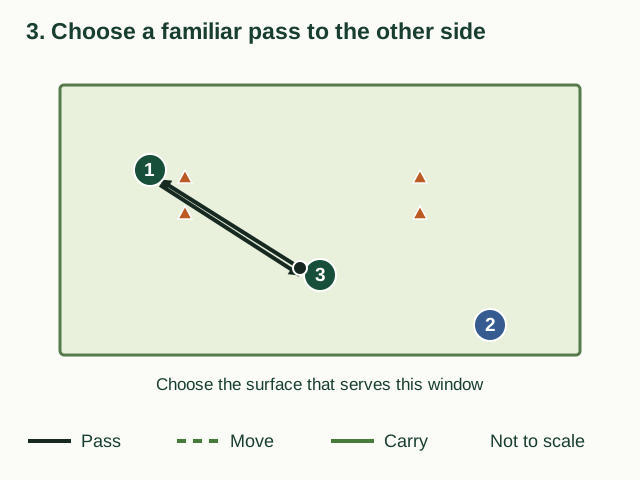
Schematic views, not to scale. Player numbers match the roles below. Dark arrows show passes, dashed green arrows show movement and solid green arrows show carries. Use the written dimensions when marking your area.
1. One passer and a same-side window
2. Try the outside-foot contact
3. Choose a familiar pass to the other side
Your complete 30-minute plan
Briefing, planned role changes, water and reflection are included. Add rest or stop when needed; shorten active play rather than rushing a transition.
00:00–03:00 · 3 min
Check, explain and walk the layout
Point to the outside surface of a comfortable foot, then gently nudge a still ball toward the same-side gate with that surface. Keep the movement small and natural. A player may choose their familiar pass, shorten the distance or stop if the motion feels awkward.
03:00–08:00 · 5 min
Prepare the movement
Use familiar ground passes first. Receiver 2 settles beyond a gate and returns only when the direct lane is clear. Observer 3 notices whether the receiver needs to chase. Change passer → receiver → observer after three deliveries, with everyone walking and the ball still during each swap.
08:00–17:00 · 9 min
Focused practice and role changes
Use three rounds of 2 minutes 40 seconds plus 20 seconds of rest. Keep the receiver still at the same-side gate for the passer’s chosen foot. Invite one outside-foot attempt, then one familiar pass for comparison, allowing any settling touches. Count a shared point for either delivery that stays on the ground and reaches the receiver inside the station. Three deliveries trigger the planned role swap; a miss prompts a shorter pass, not a stronger swing.
17:00–19:00 · 2 min
Water and reset
Stop every ball, offer water and rest, and check the same station and its clear buffers. Walk to the next roles while the ball remains still. Extra rest takes priority; shorten the next playing block if needed.
19:00–28:00 · 9 min
Use the choice in a game
Keep the two separate trios for the same three timed rounds. Before each pass, the receiver chooses a gate and becomes still. The passer checks the actual window and chooses an outside-foot or familiar delivery. A controlled reception followed by a usable return earns one shared point, with no bonus for a particular surface. After three deliveries, stop and rotate. A ball out resets at the centre. The adult retrieves outside the buffer after that station stops; both stations stop before retrieval from their shared gap.
28:00–30:00 · 2 min
Reflect and choose the next step
Ask which surface made that particular side pass comfortable. Keep the experiment only when the child can control it; a reliable familiar pass remains a useful choice.
Watch for a useful change
- Player can identify the contact surface being explored.
- Ground pass reaches a still receiver without a chase.
- Passer chooses a familiar option when the outside-foot attempt is awkward.
Make it easier
Remove the gate target and use a still partner about 1 m away. Compare gentle contacts without trying to create speed or disguise.
When ready
Let the receiver choose either gate before the passer prepares. Keep the same distance, unlimited touches and freedom to choose the passing surface.
Ask which surface made that particular side pass comfortable. Keep the experiment only when the child can control it; a reliable familiar pass remains a useful choice.
If conditions change
Stop active play when the surface, weather or available clear space is unsuitable. Use an indoor area only if it can hold the full written footprint and buffers. Otherwise keep the ball still, walk through the roles without pressure, and reschedule the live game. Extra rest takes priority over finishing the timetable.
Need a different group size or duration?
The worked example above uses the stated numbers. The related complete session has its own checked customizer, maps and rotations.
Open Pass Through GatesCoaching principles and further reading
A passing activity can give children room to explore different foot surfaces while judging whether the delivery reaches a teammate accurately.
Sources reviewed for this practice on 25 October 2026. Session Pitch created this worked example, timing, role instructions and diagrams; it is not a reproduction of the linked sessions. No FA or FIFA endorsement is implied. Live coaching effectiveness has not been evaluated.