A worked practice for your team
Keep two defending lines connected
Help a front pair and rear pair reduce the empty space between them while retaining room to cover a pass beyond the front line.
ZIP includes the printable coach card, all three SVG diagrams, timeline and practice data. Extract the folder before opening the card.
Check the problem
The front pair moves toward the ball but the rear pair stays beside the end line. An opponent waits comfortably between them. Alternatively, all four stand in one flat line, leaving no cover behind. Compare those pictures with two connected lines that can adjust together.
Set up the space and roles
Use four cones for a 24 × 28 m rectangle and four side cones to show its thirds. Keep 2 m clear outside, a 28 × 32 m footprint. Players 1–4 attack the right end initially; 5/6 begin as the front defending pair and 7/8 as the rear pair. Use one ball and no goalkeeper. Thirds are visual references, not restricted zones. All eight remain in the area.
Keep the rotation clear
Focused defending order is 5/6 front with 7/8 rear, then reverse; next 1/2 front with 3/4 rear, then reverse. Each player therefore rehearses both line roles. In the game, a different player takes the first restart of each cycle; positions follow the ball.
See the practice in three steps
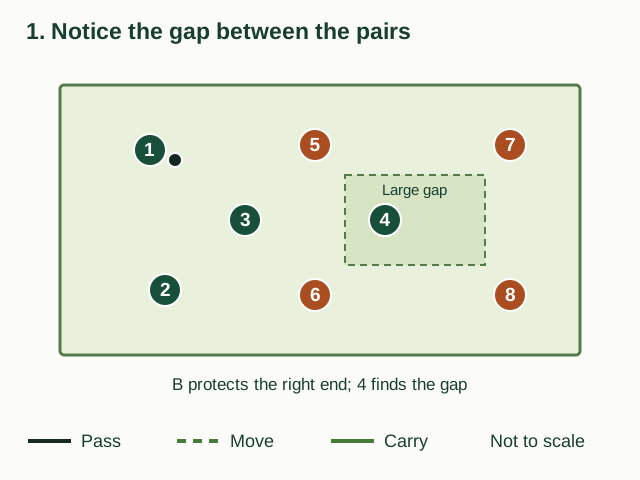
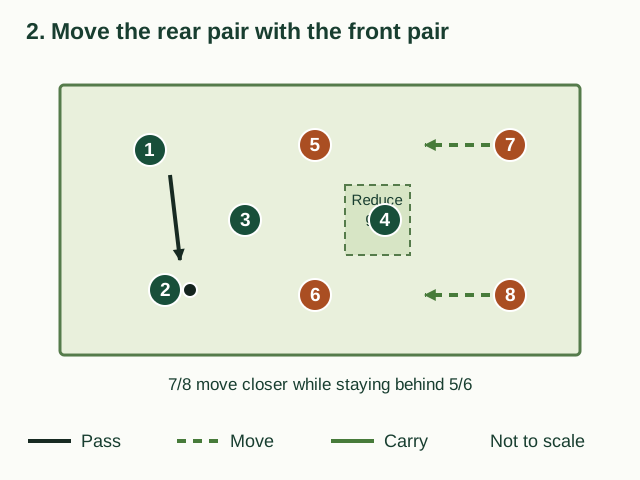
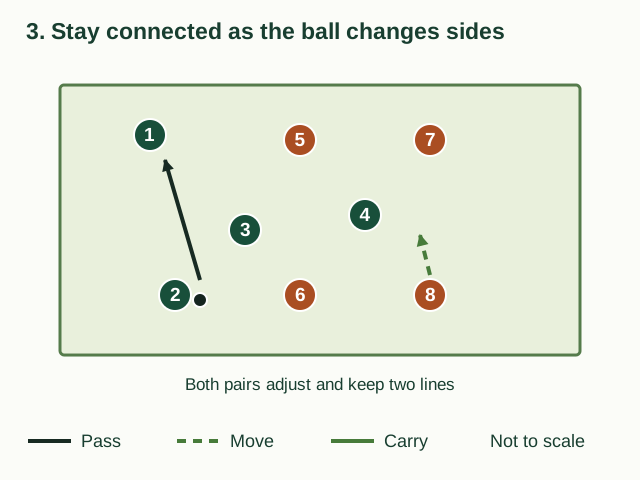
Schematic views, not to scale. Player numbers match the roles below. Dark arrows show passes, dashed green arrows show movement and solid green arrows show carries. Use the written dimensions when marking your area.
1. Notice the gap between the pairs
2. Move the rear pair with the front pair
3. Stay connected as the ball changes sides
Your complete 30-minute plan
Briefing, planned role changes, water and reflection are included. Add rest or stop when needed; shorten active play rather than rushing a transition.
00:00–03:00 · 3 min
Check, explain and walk the layout
Walk the ball sideways with the attacking four while defenders watch from a clear gap. Show a large gap between the pairs, then ask 7/8 to move toward 5/6 until they can help protect the next pass. Keep the rear pair behind the front pair. Explain that the useful distance changes with the actual passing route; nobody must hold a prescribed number of metres.
03:00–08:00 · 5 min
Prepare the movement
Use two two-minute walking rehearsals with a 30-second rest after each. Team A moves the ball first while B adjusts its two lines; swap after the pause. Attackers use settling touches and occasional returns. Defenders do not intercept yet. Ask which space appeared when one pair moved and the other stayed still.
08:00–17:00 · 9 min
Focused practice and role changes
Run four cycles of 1 minute 55 seconds and 20 seconds of rest, totalling nine minutes. A attacks in cycles one and two; B in three and four. Swap front and rear pairs for the second cycle of each team’s defending turn. Attackers score one point for a controlled ground reception beyond the far end line. Defenders may intercept ground passes, then stop and return possession for the next attack. Keep at least 1 m from carriers and 2 m from off-ball receivers; protect lanes without entering another player’s path. Restart from the attacking end after any point, interception or ball out, with defenders 3 m away.
17:00–19:00 · 2 min
Water and reset
Pause for water and check the surface and clear buffers. Keep the same marked playing area and its clear outside buffer. Extra rest takes priority; shorten the next playing block if needed.
19:00–28:00 · 9 min
Use it in a game
Play 4v4 for four more cycles of 1 minute 55 seconds plus 20-second rests. Use the same end-line receiving score, but an interception now starts an attack in the other direction. No player must remain in a fixed line. At each pause, ask whether the gap between the two nearest and two deeper defenders offered an easy central reception. After a point or ball out, the other team restarts at its own end with opponents 3 m back. Retain ground play, clear gaps and no foot or body tackles.
28:00–30:00 · 2 min
Reflect and choose the next step
Ask which pair needed to move when the central pocket became large. Repeat the slower picture if the team can only repair it by rushing toward a receiver.
Watch for a useful change
- Rear pair adjusts when the front pair moves.
- Two lines remain visible without a large central pocket.
- Players protect routes while retaining safe separation from opponents.
Make it easier
Keep the ball still between passes and let both pairs settle before play resumes. Let attackers announce a side pass.
When ready
Let an attacker walk into the space between the pairs before a pass. Defenders check and adjust without following so closely that the safety gap disappears.
Ask which pair needed to move when the central pocket became large. Repeat the slower picture if the team can only repair it by rushing toward a receiver.
If conditions change
Stop active play when the surface, weather or available clear space is unsuitable. Use an indoor area only if it can hold the full written footprint and buffers. Otherwise keep the ball still, walk through the roles without pressure, and reschedule the live game. Extra rest takes priority over finishing the timetable.
Need a different group size or duration?
The worked example above uses the stated numbers. The related complete session has its own checked customizer, maps and rotations.
Open Hand Over the Far SideCoaching principles and further reading
Coordinated defenders protect passing gaps by relating their positions to teammates and the ball.
Sources reviewed for this practice on 25 October 2026. Session Pitch created this worked example, timing, role instructions and diagrams; it is not a reproduction of the linked sessions. No FA or FIFA endorsement is implied. Live coaching effectiveness has not been evaluated.