A worked practice for your team
Know when a rolling ball is fully out
Distinguish a ball overlapping the boundary from a ball wholly beyond it, then choose whether to continue or stop for a restart.
ZIP includes the printable coach card, all three SVG diagrams, timeline and practice data. Extract the folder before opening the card.
Check the problem
A child stops as soon as the ball touches the line, or follows a ball well outside while teammates stop. The middle of the ball crossing is not the whole-ball test. Make that difference visible with still positions before using a slow moving ball.
Set up the space and roles
Mark a 12 × 16 m rectangle with clear, flat line markers suitable for the surface and four corner cones. Leave 2 m clear around it, a 16 × 20 m footprint. Four more cones form two 2 m wide passing gates inside the rectangle, well away from its edges. Use one ball. Team A is 1/2 and B is 3/4. The adult manages demonstrations, final boundary decisions and retrieval.
Keep the rotation clear
All four children judge the still and rolling examples. First restart takers are 1, 3 and 2 in the focused block, then 4, 1 and 3 in the game. Teammates alternate subsequent restarts. Nobody becomes a permanent boundary official.
See the practice in three steps
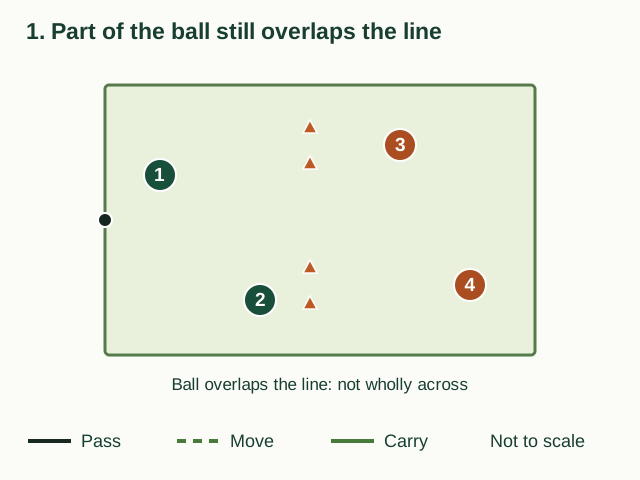
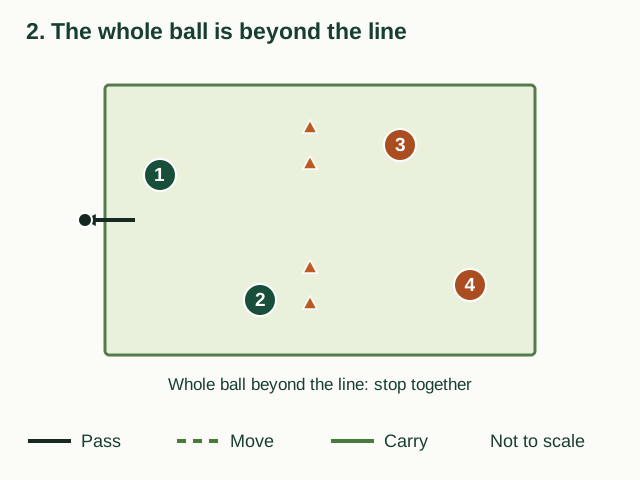
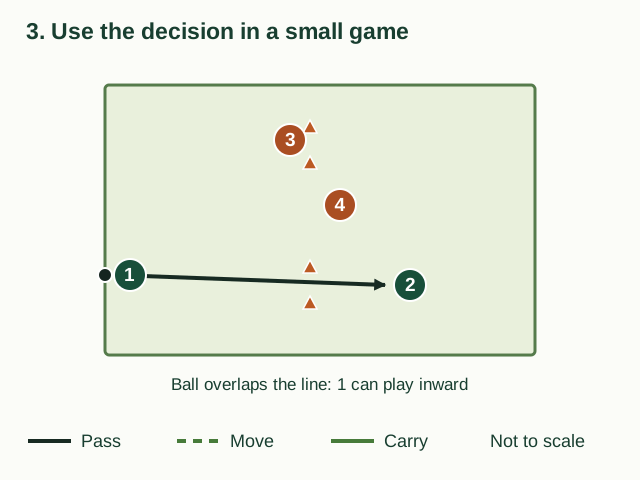
Schematic views, not to scale. Player numbers match the roles below. Dark arrows show passes, dashed green arrows show movement and solid green arrows show carries. Use the written dimensions when marking your area.
1. Part of the ball still overlaps the line
2. The whole ball is beyond the line
3. Use the decision in a small game
Your complete 30-minute plan
Briefing, planned role changes, water and reflection are included. Add rest or stop when needed; shorten active play rather than rushing a transition.
00:00–03:00 · 3 min
Check, explain and walk the layout
Place the ball on the line, partly beyond its outside edge, then fully clear of it. Let children point to the ball’s full outline. For the crossing test, any part still over the line means it has not wholly crossed. Explain separately that an adult stop signal always pauses this activity. Read the practice restart rule before playing.
03:00–08:00 · 5 min
Prepare the decision
Use two two-minute demonstrations with a 30-second rest after each. The adult gently rolls the ball toward a boundary while all four children stay clear. Pair 1/2 makes the first decision; 3/4 explains what they saw, then exchange jobs. Compare a ball still overlapping the line with one fully clear. Nobody runs after these demonstration balls; the adult collects after everyone stops.
08:00–17:00 · 9 min
Focused practice and role changes
Play 2v2 for three rounds of 2 minutes 40 seconds plus 20 seconds of rest. A controlled ground pass through either inside gate to a teammate earns one point. Let play continue while a ball overlaps a boundary, unless the adult pauses it. When it wholly crosses, stop together. After a point or wholly-out ball, use the practice restart routine described below. A child can request a pause if unsure; the adult checks and replays the position without a penalty. Defenders intercept ground passes only, keep 1 m from carriers and leave moving players a clear path; no foot or body tackles.
17:00–19:00 · 2 min
Water and reset
Pause for water, then check the marked area and clear buffers. Check that the flat boundary markers remain clear and secure before the game. Extra rest takes priority; shorten the next playing block if needed.
19:00–28:00 · 9 min
Use it in a game
Use three more rounds of 2 minutes 40 seconds plus 20-second pauses. Keep the gate score. Players first indicate whether a boundary ball crossed completely; the adult confirms, then retrieves it after the stop. Practice restart rule: after any wholly-out ball, the opponents of the last toucher take a stationary ground pass from the nearest boundary, with opponents 3 m back. After a point, the other team restarts from the centre with the same retreat. These ground restarts are this learning game’s rules; local youth matches may use different restarts. Check the competition’s rules before using them in a match.
28:00–30:00 · 2 min
Reflect and choose the next step
Show one overlapping and one fully-out position again. Ask what changed, then restate that today’s ground restart is a practice choice.
Watch for a useful change
- Child looks for the whole outline beyond the line.
- Players continue with an overlapping ball or stop together after a confirmed exit.
- An uncertain player requests a pause instead of chasing or arguing.
Make it easier
Return to a stationary ball and a single clearly marked line. Let children view from a safe position along the line before deciding.
When ready
Vary which boundary the slow ball approaches. Keep the speed comfortable and the adult’s confirmation available.
Show one overlapping and one fully-out position again. Ask what changed, then restate that today’s ground restart is a practice choice.
If conditions change
Stop active play when the surface, weather or available clear space is unsuitable. Use an indoor area only if it can hold the full written footprint and buffers. Otherwise keep the ball still, walk through the roles without pressure, and reschedule the live game. Extra rest takes priority over finishing the timetable.
Need a different group size or duration?
The worked example above uses the stated numbers. The related complete session has its own checked customizer, maps and rotations.
Open Boundary BrakesCoaching principles and further reading
For a boundary-crossing decision, IFAB Law 9 requires the entire ball to pass beyond the touchline or goal line; crossing with only part of the ball is insufficient.
Sources reviewed for this practice on 25 October 2026. Session Pitch created this worked example, timing, role instructions and diagrams; it is not a reproduction of the linked sessions. No FA or FIFA endorsement is implied. Live coaching effectiveness has not been evaluated.