A worked practice for your team
Rebuild control after a loose first touch
After a first touch runs too far, regain a still, reachable ball and a clear target view before attempting a ground finish.
ZIP includes the printable coach card, all three SVG diagrams, timeline and practice data. Extract the folder before opening the card.
Check the problem
The first touch runs away and the child shoots while reaching after it. Calling for accuracy misses the earlier problem: the ball was never ready to strike. Give recovery its own successful outcome, separate from scoring.
Set up the space and roles
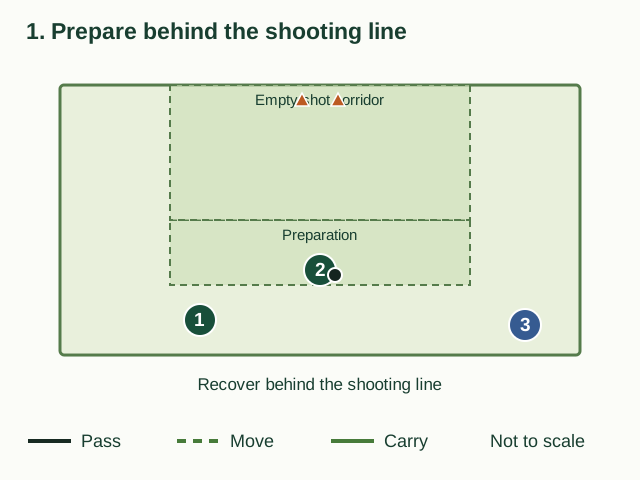
Mark two 8 × 14 m stations, each with four corners, a two-cone shooting line 5 m from the target and a 2 m empty target gate. Eight cones and one ball serve each trio. Leave 4 m between stations and 2 m outside: the full footprint is 24 × 18 m. The 3 m strip immediately behind the shooting line is the preparation strip. Server 1 passes from behind this strip to receiver 2; observer 3 stays on a side behind the strip and outside the central 4 m shot corridor. Repeat with 4/5/6.
Keep the rotation clear
Use 1 server, 2 receiver, 3 observer, then rotate one place at each round pause; repeat for 4/5/6. Everyone receives for a full round in each block. The observer reports ball readiness and never stands near the target or retrieves during a live attempt.
See the practice in three steps
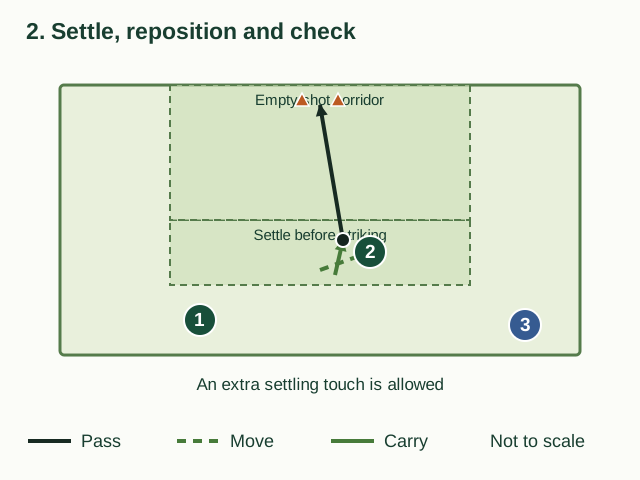
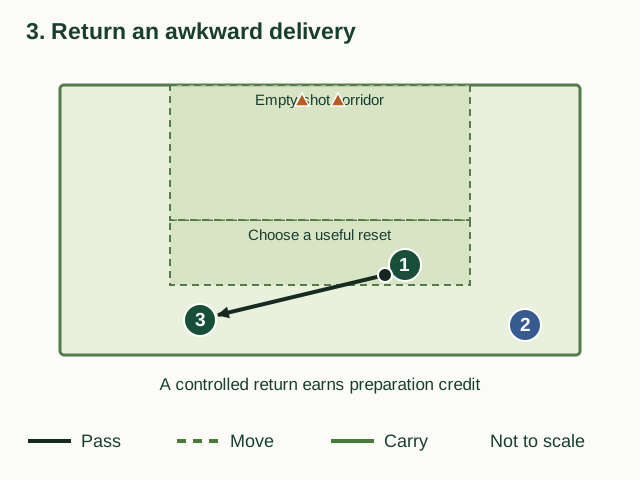
Schematic views, not to scale. Player numbers match the roles below. Dark arrows show passes, dashed green arrows show movement and solid green arrows show carries. Use the written dimensions when marking your area.
1. Prepare behind the shooting line
2. Settle, reposition and check
3. Return an awkward delivery
Your complete 30-minute plan
Briefing, planned role changes, water and reflection are included. Add rest or stop when needed; shorten active play rather than rushing a transition.
00:00–03:00 · 3 min
Check, explain and walk the layout
Show a gentle first touch that rolls one comfortable step away. Follow at walking pace, settle the ball, step into a comfortable position beside it, look at the empty target and finish. If the ball has crossed the shooting line, stop it and carry it back before rebuilding. Never shoot while chasing into the target area.
03:00–08:00 · 5 min
Prepare the movement
Use slow ground passes. The receiver settles and returns without shooting. Explore a comfortable first touch slightly ahead, then recover the still ball within the preparation strip. Rotate after three passes. Do not ask for an exaggerated mistake or a hard delivery. Pause after an escaped ball and shorten the next pass. Stop both stations before retrieving from their shared gap or a neighbouring station.
08:00–17:00 · 9 min
Focused practice and role changes
Play three rounds of 2 minutes 40 seconds plus 20 seconds to rest and rotate server → receiver → observer. A receiver may deliberately let a gentle touch travel one step, then settle, reposition and check. Award one shared preparation point for rebuilding a reachable ball behind the line; add one for a ground target finish. After every shot, all players stop; the shooter retrieves the stationary ball only on the clear signal, outside any neighbouring lane.
17:00–19:00 · 2 min
Water and reset
Stop every ball, offer water and rest, and check the same station and its clear buffers. Walk to the next roles while the ball remains still. Extra rest takes priority; shorten the next playing block if needed.
19:00–28:00 · 9 min
Use the choice in a game
Keep the trios and the same three timed rounds. Servers vary a gentle delivery slightly left or right within reach. The receiver decides whether the ball is ready, needs settling, or needs returning. A controlled return after an awkward delivery earns one preparation point too. A reachable finish through the empty gate adds one. A chase-and-poke earns neither; stop the attempt and restart with a gentler pass. Once a ball leaves the strip, recover it at walking pace and restart from the strip before shooting.
28:00–30:00 · 2 min
Reflect and choose the next step
Ask what made the ball ready again. Keep preparation and target points separate so that a useful recovery remains visible even when the finish misses.
Watch for a useful change
- Receiver settles an escaping ball before striking.
- Player rebuilds behind the shooting line or chooses a return.
- Feet and target view are prepared before the ground finish.
Make it easier
Start with a still ball one step away and practise recovery followed by a return. Add the target only when preparation is comfortable.
When ready
Vary the side of the gentle delivery. Keep enough time for settling; do not add a countdown or a first-time finish.
Ask what made the ball ready again. Keep preparation and target points separate so that a useful recovery remains visible even when the finish misses.
If conditions change
Stop active play when the surface, weather or available clear space is unsuitable. Use an indoor area only if it can hold the full written footprint and buffers. Otherwise keep the ball still, walk through the roles without pressure, and reschedule the live game. Extra rest takes priority over finishing the timetable.
Need a different group size or duration?
The worked example above uses the stated numbers. The related complete session has its own checked customizer, maps and rotations.
Open Finish from a PassCoaching principles and further reading
Shooting distance and task difficulty can be reduced so that the child can attempt an accurate finish.
Sources reviewed for this practice on 25 October 2026. Session Pitch created this worked example, timing, role instructions and diagrams; it is not a reproduction of the linked sessions. No FA or FIFA endorsement is implied. Live coaching effectiveness has not been evaluated.