A worked practice for your team
Roll a short underarm pass along the ground
Explore a gentle underarm release that rolls along the ground toward a ready teammate instead of dropping and bouncing.
ZIP includes the printable coach card, all three SVG diagrams, timeline and practice data. Extract the folder before opening the card.
Check the problem
The child lets go high above the ground, so a short distribution bounces or makes the receiver chase. Begin close enough to compare a low gentle release with an accidental drop, without asking for speed or a longer throw.
Set up the space and roles
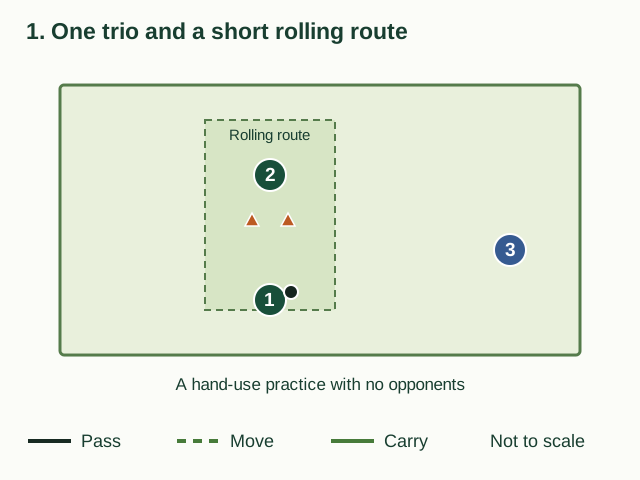
Mark two 6 × 8 m stations. Each uses four corner cones and two for a 2 m receiving gate, six cones and one ball per trio. Leave 4 m between stations and 2 m outside: the clear footprint is 20 × 12 m. Player 1 rolls from about 2 m away to ready receiver 2 beyond the gate; observer 3 stands at least 2 m to the side of the rolling route. Players 4/5/6 repeat separately. These closed exercises permit hand use in the named roles; they are not matches or examples of match handling laws.
Keep the rotation clear
Start 1 roller, 2 receiver, 3 observer and 4/5/6 identically. Rotate roller → receiver → observer at each focused and game round pause, giving everyone one complete round per role in each block. Reset to these start roles after the warm-up. Receivers may use hands only to collect and carry the already stopped ball.
See the practice in three steps
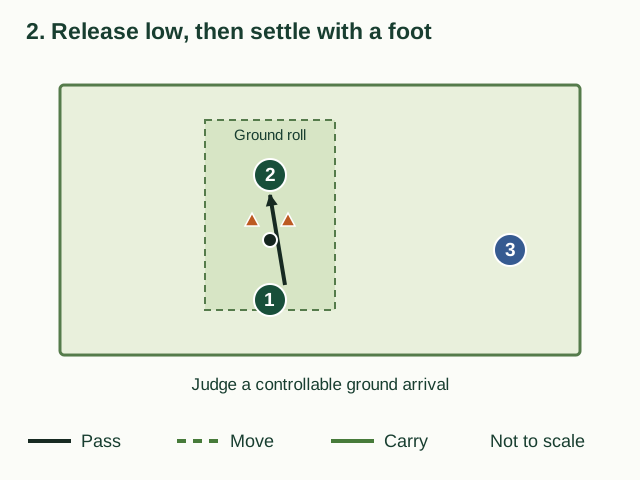
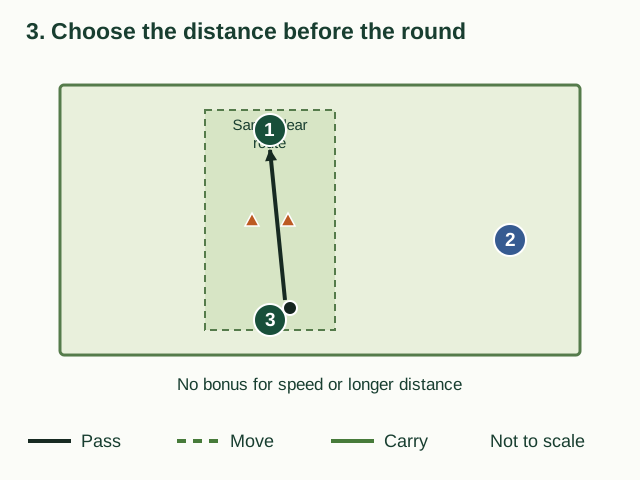
Schematic views, not to scale. Player numbers match the roles below. Dark arrows show passes, dashed green arrows show movement and solid green arrows show carries. Use the written dimensions when marking your area.
1. One trio and a short rolling route
2. Release low, then settle with a foot
3. Choose the distance before the round
Your complete 30-minute plan
Briefing, planned role changes, water and reflection are included. Add rest or stop when needed; shorten active play rather than rushing a transition.
00:00–03:00 · 3 min
Check, explain and walk the layout
An adult demonstrates lowering a held ball comfortably, moving the hand gently forward near the surface and releasing an underarm roll. Stay on the feet with knees off the ground. The receiver settles with a foot, then may pick up the still ball. Use a shorter delivery or adult help whenever needed.
03:00–08:00 · 5 min
Prepare the hand-use task
At about 1 m, the roller releases gently to a still partner without the gate requirement. The receiver stops the ball with a foot, picks it up and walks it back for a stationary handover; there is no return throw. Keep the ball still while anyone walks. Change roller → receiver → observer after three deliveries, including misses.
08:00–17:00 · 9 min
Focused practice and role changes
Use three rounds of 2 minutes 40 seconds plus 20 seconds to rest and rotate the three roles. Begin at 2 m. A shared point requires a ground roll through the gate that reaches the ready receiver without a chase. If it bounces or escapes, stop, retrieve the still ball and restart closer. The observer reports the first bounce or a controllable arrival rather than judging body shape. The receiver carries the stopped ball back after every attempt.
17:00–19:00 · 2 min
Water and reset
Stop every ball, offer water and rest, and check the same stations and clear buffers. Confirm the next hand-use roles before restarting. Extra rest takes priority; shorten the next playing block if needed.
19:00–28:00 · 9 min
Use control in a cooperative game
Keep the separated trios for the same three timed rounds. Before each round, the receiver chooses a comfortable 1–2 m delivery or, if both agree, up to 3 m. Keep that distance fixed for the round. A ground delivery the receiver can settle earns one shared point; there is no speed or distance bonus. A bouncing or wide roll resets without a penalty. Everyone stops before retrieval; both stations stop if a ball enters the shared gap, and an adult manages any retrieval beyond the buffer.
28:00–30:00 · 2 min
Reflect and choose the next step
Ask which release made the arrival easiest to control. Repeat the shorter roll if the ball bounced; there is no need to increase distance today.
Watch for a useful change
- Release produces a gentle ground roll rather than a drop.
- The ready receiver can settle without chasing.
- Roller reduces distance or asks for help when control is lost.
Make it easier
Use a 1 m roll to a still partner without a gate. An adult may return or hold the ball while the child explores a comfortable release.
When ready
Let the receiver choose a comfortable distance before the round, never beyond 3 m. Keep the target still and the release gentle; add no opponent or airborne throw.
Ask which release made the arrival easiest to control. Repeat the shorter roll if the ball bounced; there is no need to increase distance today.
If conditions change
Stop active play when the surface, weather or available clear space is unsuitable. Use an indoor area only if it can hold the full written footprint and buffers. Otherwise keep the ball still, walk through the roles without pressure, and reschedule the live game. Extra rest takes priority over finishing the timetable.
Need a different group size or duration?
The worked example above uses the stated numbers. s05 is a separate foot-passing lesson. Its session customizer does not adapt this fixed hand-use practice.
Open Pass Through GatesCoaching principles and further reading
A short underarm distribution can use a low release so that a nearby teammate receives a manageable ball.
Sources reviewed for this practice on 25 October 2026. Session Pitch created this worked example, timing, role instructions and diagrams; it is not a reproduction of the linked sessions. No FA or FIFA endorsement is implied. Live coaching effectiveness has not been evaluated.